
A dark basement can turn into a bright family room, workshop, or media space with the right fixtures. One surprising finding from current product research is that some of the brightest garage-style lights need no new wiring. Here are the top basement lighting ideas for Utah homes, plus who each option suits best.
1. LIFT Construction: Integrated lighting for a fully finished basement
LIFT Construction is the best fit when lighting needs to work with the whole basement remodel, not sit apart from it. We plan fixtures around ceiling height, room use, framing, insulation, and the final finish.
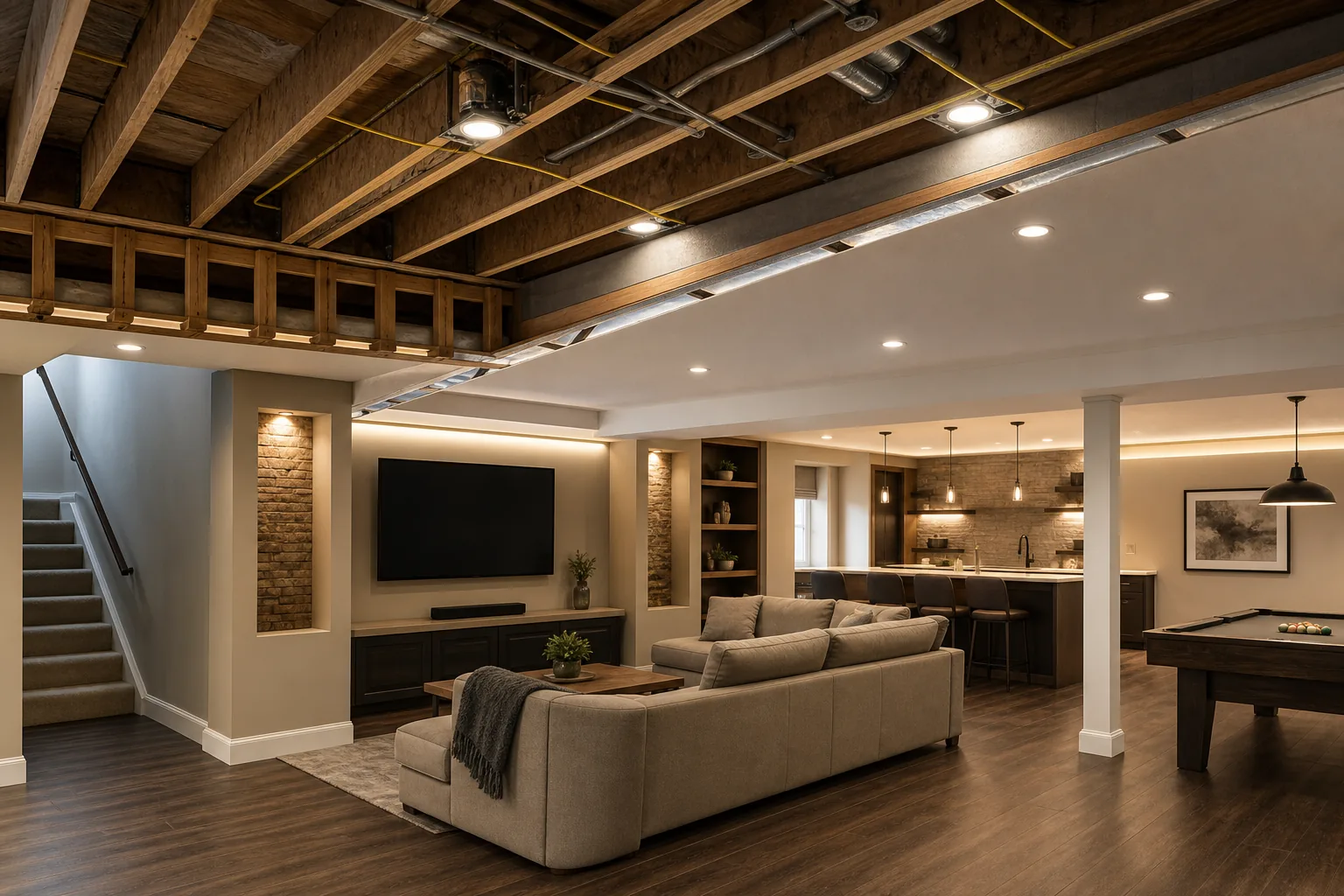
That matters in Northern Utah homes. A basement may include a low media room ceiling, an open play area, a bathroom, and a stair landing. One light type rarely handles all four zones well. We can place recessed fixtures over walk paths, add focused light near a desk or wet bar, then use dim controls where a softer mood makes sense.
We also look at access before any wiring begins. Finished ceilings leave little room for mistakes. During a remodel, our team can coordinate lighting with ductwork, soffits, beams, smoke alarms, and other parts of the build. That helps keep fixtures centered instead of forcing awkward placement after drywall is up.
Homeowners planning a theater or family room can pair the lighting plan with broader Salt Lake County basement finishing work. The goal is a room that feels planned from start to finish, not a collection of lights added one at a time.
We recommend LIFT Construction when you need new circuits, a full ceiling plan, or several rooms finished at once. A DIY fixture swap may cost less upfront, but it won’t solve layout issues hidden above the ceiling.
Best for: Finished basements, multi-room remodels, media rooms, and homeowners who want one team to manage the work.
Watch for: A full remodel needs a wider budget and schedule than replacing a single fixture. We help define that scope before work begins.
2. Amico Recessed Lighting Kit: Even LED coverage across the whole basement
The Amico recessed lighting kit is designed for homeowners who want consistent light across a full basement. Its research listing describes DIY-friendly installation through a universal E26 base, so an electrician isn’t required for that fixture swap when the existing setup is suitable.
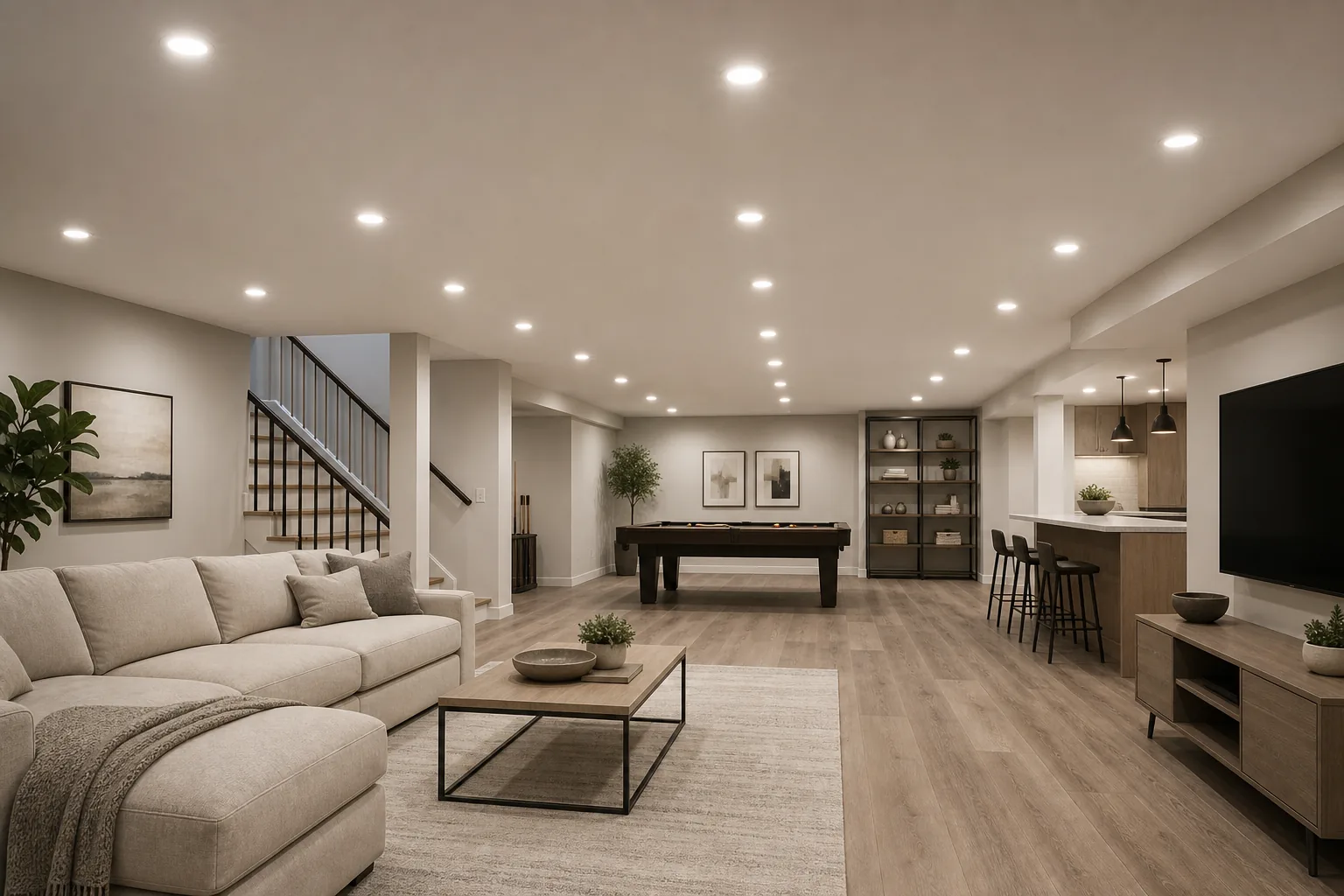
The kit stands out because each light is listed at 1,050 lumens and 12 watts. It also has five selectable color temperatures, ranging from warm light to daylight. That lets one basement feel cozy during movie night and clearer during laundry or hobby work.
Its dimming range is listed from 5% to 100% with most standard dimmers. The larger trim size can also help cover oversized ceiling holes or rough drywall edges. That is useful in a remodel where old fixtures left imperfect openings.
Light output is measured in lumens, while watts measure power use. The distinction matters because a higher watt number doesn’t always mean more visible light. A lumen is the unit used to measure visible light, so compare lumen output when you judge coverage.
We like this choice for a basement with a regular ceiling grid and several matching fixture locations. It is less useful when joists, ducts, or low beams make recessed placement hard.
Best for: Even room-wide coverage, a full fixture refresh, and homeowners who want adjustable color temperature.
Caveat: DIY-friendly doesn’t mean every basement is DIY-safe. New circuits or changes to house wiring may need a qualified electrician and local approval.
3. HALO Recessed Trim Kit: A quick LED refresh for existing cans
The HALO recessed trim kit is best for basements with existing recessed cans that need a quick LED upgrade. If your basement already has recessed cans in place, this option can refresh the lighting without changing the overall fixture layout.
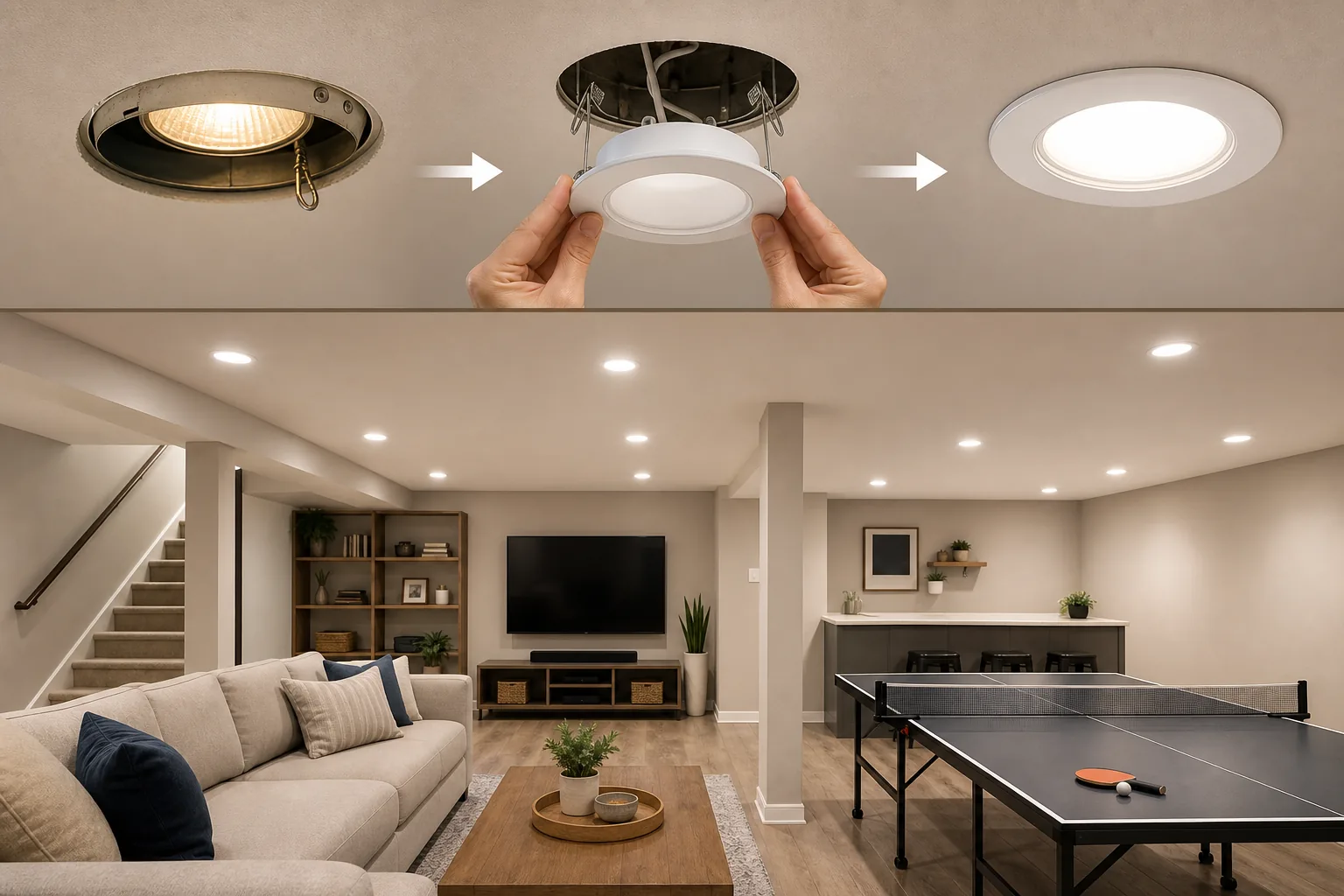
This makes the kit a practical choice for homeowners who want a straightforward update to existing recessed lighting. It focuses on upgrading the cans already in the basement rather than adding a new lighting arrangement.
The installation is DIY-friendly, so no electrician is required. That can make this a convenient option for Utah homeowners taking on a manageable basement improvement project themselves.
This option works best when the recessed cans are already installed where you need them. If your basement needs a different lighting layout, consider a broader plan before choosing a trim upgrade.
We’d choose the HALO recessed trim kit when the goal is a quick LED upgrade for existing recessed cans. It keeps the project focused on refreshing the lighting already in place.
Best for: Basements with existing recessed cans that need a quick LED upgrade.
Watch for: This DIY-friendly option is intended for existing recessed cans, so confirm that your basement has cans in place before choosing it.
4. Skymoatled Shop Lights: Maximum brightness for unfinished work areas
Skymoatled shop lights are designed for unfinished basements, workshops, and large open areas where visibility matters more than a polished ceiling. The listed four-foot fixtures are intended for spaces where raw brightness matters.
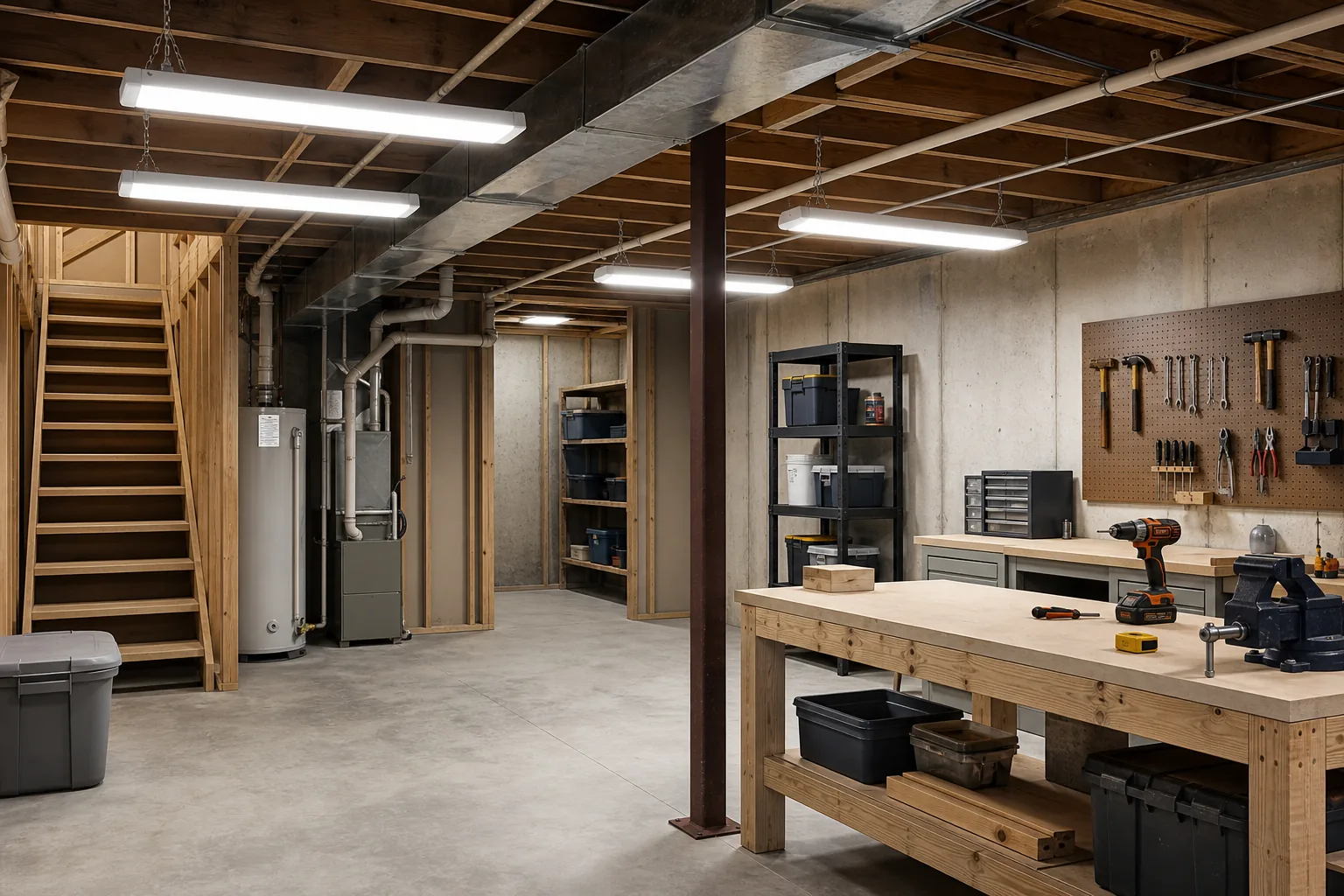
That kind of output can make a storage room or workbench much easier to use. The linkable design also lets several fixtures run in a line, which helps reduce the dark gaps common in open basements. Surface-mount and hanging options give you more ways to work around exposed joists.
The mounting hardware in the research listing is described for wood, drywall, or concrete ceilings. Those details are useful when the basement is still a work zone and access to fixtures may be less convenient later.
LEDs can produce high light output with less power than older light sources. For a basement that needs efficient, long-lasting light, LED lighting guidance can offer useful general context.
The trade-off is visual. Long shop lights look at home above a workbench, but they may feel out of place over a finished seating area. They also need a plan for cords or wiring if there isn’t an existing outlet nearby.
Best for: Unfinished basements, workshops, storage rooms, and spaces where raw brightness comes first.
Decision rule: Pick this style when you need to see tools, boxes, or laundry clearly. Pick recessed or flush fixtures when the ceiling itself is part of the room’s design.
5. Hepside Flush Mount Lights: Affordable, low-profile LED style
Hepside flush mount lights are designed for budget-minded homeowners who need a low-profile fixture with a modern look. Flush mounts sit close to the ceiling, which makes them a strong match for Utah basements with ceilings around seven feet or less.
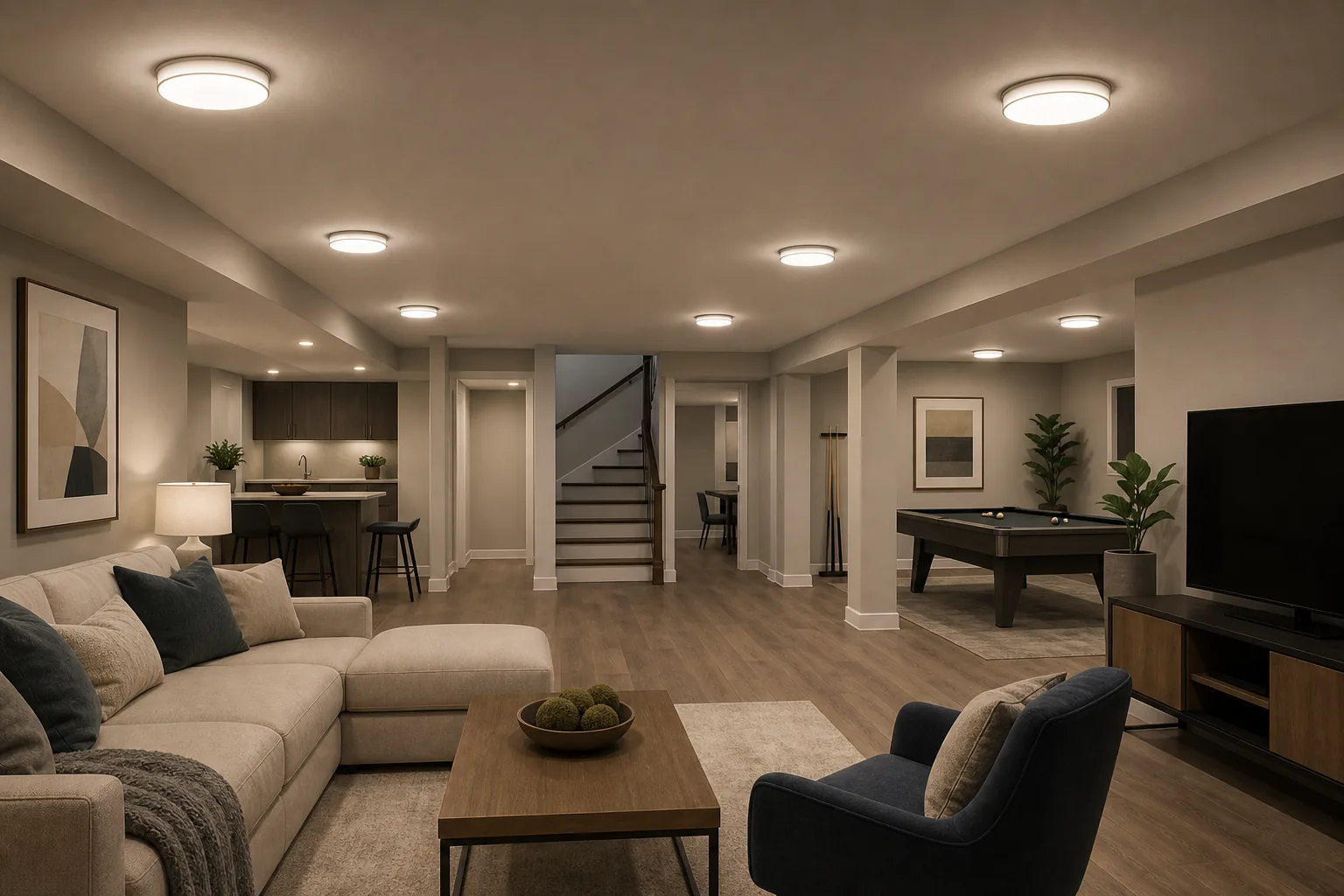
The research places this type of light in the affordable LED category, with decent brightness and low visual bulk. That combination works well in a hallway, laundry room, bedroom, or small family space where a hanging fixture could feel crowded.
Low clearance is more than a style concern. A fixture that drops several inches can make a short ceiling feel lower and may sit in the way near stairs or a walking path. A flat fixture keeps the headroom clear while spreading light across the room.
Flush mounts can also help when recessed cans aren’t possible. Joists, ducts, concrete, or limited access may block recessed installation. In those cases, a surface fixture can give you useful coverage without major ceiling work.
The limitation is control. A single flush mount may light the center of a room while leaving a desk, stair, or storage wall dim. Add a task light where you work, or use more than one fixture if the room is long.
We often pair low-profile ceiling fixtures with the rest of a basement plan instead of treating them as the only light source. For a Syracuse family room, for example, the same space may need bright general light during play time and softer light later. Layout comes first.
Best for: Low ceilings, small rooms, budget-focused updates, and homeowners who want a simple modern fixture.
Caveat: Confirm the fixture’s size, junction-box fit, color setting, and dimmer support before installation. Product details can vary by model.
Basement Lighting Ideas Compared: Best Option by Space and Project Type
The best basement lighting ideas depend on the room’s finish level and the work you expect to do there. Current research also shows a useful split: many listings focus on DIY installation, but far fewer clearly explain the quality or type of light they provide.
Use this table as a quick filter. Then look at placement, ceiling height, and wiring before you buy.
| Basement space or project | Best match | Why it fits | Main caution |
|---|---|---|---|
| Full basement remodel | LIFT Construction | Lighting can be planned with walls, ceilings, rooms, and controls. | Needs a larger project scope than a fixture swap. |
| Finished room with new recessed locations | Amico recessed lighting kit | Room-wide coverage with selectable color temperature. | Check ceiling access and circuit needs. |
| Existing recessed cans | HALO recessed trim kit | Fast retrofit without changing the whole ceiling layout. | Won’t fix poor fixture spacing. |
| Unfinished workshop | Skymoatled shop lights | High output and wide coverage suit open work areas. | Industrial look may not suit a finished room. |
| Low-ceiling room | Hepside flush mount lights | Low profile keeps headroom open. | One center fixture may leave task areas dim. |
For a finished basement, we usually suggest layers. Start with general ceiling light. Then add task light at a desk, counter, or workbench. Use dimming where the room has more than one job.
If the project includes bedrooms, a playroom, or a study nook, the layout should support those uses from the start. Our Syracuse basement finishing ideas show why lighting works best when it follows the room plan.
New wiring is a different job from replacing a trim. If you need new circuits, ask a licensed professional to review the plan before the ceiling closes.
More basement lighting tips
Daylight-sensitive and zoned controls, room-by-room power use
Daylight-sensitive and zoned controls fit Utah basements with windows, mixed-use rooms, or several separate areas. These controls are among the more flexible finished basement lighting ideas for energy savings because they keep unused fixtures off instead of treating the entire basement as one room.
A daylight-sensitive control can reduce electric light when a nearby window supplies enough daylight. It works best near egress windows or walkout basement doors. It has less value in a windowless storage room, where there is no daylight to measure.
Zoning is simpler. Put the family room on one switch, the office on another, and the hall on its own control. In a large basement, split the ceiling lights into smaller groups so one person can work without lighting every corner. The goal is a control that matches how the room is used.
We also look at the ceiling before choosing control locations. A dropped ceiling may make future wiring changes easier. A fully finished drywall ceiling needs a cleaner plan before installation. Homeowners working with a small or narrow basement can review basement lighting ideas for small Utah spaces before deciding which zones deserve their own switch.
The tradeoff is added planning. More zones mean more switches, dimmers, or control hardware. Too many controls can confuse guests and family members. Keep the layout easy to explain: one switch for the main room, one for task areas, and one for paths or stairs when the floor plan calls for it.
Published lighting data is often thin. A Utah homeowner should ask for fixture wattage, expected operating hours, control type, and installed cost instead of relying on the phrase energy efficient alone.
Shaded Wall Sconces: Vertical light that saves ceiling space
Shaded wall sconces mount on the wall and add light at eye level. They’re best for small basements with low ceilings, narrow halls, or walls where a ceiling fixture would compete with beams and ductwork.
The HGTV gallery places shaded wall sconces on walls. This gives homeowners a clear way to add a second light layer without filling the ceiling with downlights. A shade can also soften the source, which helps a lounge feel less stark than a room lit only from above.
Sconces work best when their location follows movement. A pair beside a media cabinet can frame that wall. One near a stair landing can help mark the transition between levels. In a narrow passage, the fixture should sit where people won’t brush against it while carrying boxes or furniture.
We check door swings, trim height, furniture depth, and switch reach before setting a sconce location. The wall may look empty during framing, but the finished space can have a sofa, shelf, or art piece that changes the usable height.
Shade shape affects the light pattern. An upward opening can send light toward the ceiling. A downward opening puts more light on the wall below. A closed shade can reduce glare but may feel too dim for a task zone. The right choice depends on what the wall needs to do.
One caution: wall sconces need more than a good-looking wall location. Their boxes, wiring, and switch plan must be set before drywall. If a finished wall has no power nearby, the install may take more repair work than the fixture suggests.
Dimmable LED task and accent lighting, flexible zones for family spaces
Dimmable LED task and accent lighting is best for a basement that changes jobs throughout the day. The same room might be a play space in the afternoon, a reading area after dinner, and a movie room later. Separate zones let you light only the area in use.
Start with the task. A desk needs light aimed at the work surface. A wet bar needs light that reaches the counter without shining into someone’s eyes. A stair wall may need a low level of accent light so the path is easy to see. General ceiling lights can then run at a lower setting instead of lighting the whole basement at full output.
Choose dimmable fixtures and compatible dimmers as a set. A mismatch can cause flicker, buzzing, or a narrow dimming range. We also check where the control should sit. A switch at the room entry may work for a family room, while a control near the sofa may be more useful for a theater.
Accent light should support the room instead of becoming the room’s main source. A soft wash on a stone wall or shelf can add depth at a low setting. But too many small fixtures increase wiring work and can make the ceiling look busy. Pick the areas that need attention first.
Small Retrofit Fixtures – Budget-Friendly Retrofit Option
A small retrofit fixture is aimed at homeowners who want a smaller recessed look during a retrofit. Its compact size can work well in bedrooms, short halls, closets, or small finished basement rooms.
A four-inch fixture can look less busy than a larger downlight when the ceiling is divided by beams or soffits. Smaller openings may also suit a room with several zones. For example, a basement office could use a few downlights over the desk area instead of a dense row across the full ceiling.
Retrofit work still needs a layout plan. Check the existing ceiling, insulation, joist placement, and wire path before cutting. If the basement is already finished, access can be harder and patch work can add labor. A low fixture price does not tell you the full project cost.
Use this option when the room is modest and the ceiling needs a neat, low-profile look. It may be less suitable for a large open basement where small fixtures need to be installed in many rows. In that case, compare the total fixture count and labor, not only the cost of one light.
Color temperature should stay consistent with nearby fixtures. Mixing a cool office light with warm hallway lights can make the basement feel pieced together. Test one fixture in the room before committing to the whole set.
FAQ
What is the best lighting for a basement?
The best basement lighting combines even overhead coverage with task or accent light where you use the room. Recessed LEDs suit finished ceilings, while shop lights suit unfinished work areas. Flush mounts work well under low ceilings. A full remodel may need several fixture types instead of one product throughout.
How many recessed lights should a basement have?
The number of recessed lights depends on ceiling height, room size, fixture output, and layout. A common planning idea is to space fixtures about half the ceiling height apart. Treat that as a starting point, then adjust around beams, ducts, furniture, and task zones.
What color light is best for a basement?
Warm light around 2700K to 3000K feels better in family rooms and media spaces. Neutral light near 4000K can suit laundry areas or hobby rooms. Daylight settings can help in workshops. Adjustable fixtures are useful when one basement room has several jobs.
Can homeowners install basement lights themselves?
You can often replace a compatible fixture yourself if the wiring and electrical box are already in place. Many listed basement lights are DIY-friendly or plug in without new wiring. New circuits, altered wiring, damp areas, or uncertain connections call for a qualified electrician.
Are LED shop lights good for unfinished basements?
LED shop lights are a strong choice for unfinished basements because they spread high-output light across open areas. They work well above workbenches, storage zones, and laundry areas. Their long shape and industrial look may feel wrong after finishing, so plan to replace them if the space becomes a living room.
Conclusion
Choose LIFT Construction when your lighting is part of a larger Northern Utah basement remodel. For a small update, match the fixture to the ceiling and room use first. The next step is to sketch each activity zone, then have the wiring and fixture layout reviewed before you close the ceiling.